
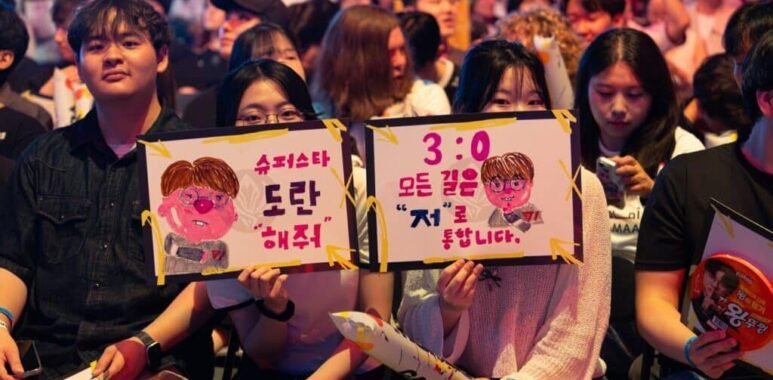
If they call me that, I need a performance that matches: I witnessed the Faker fandom at MSI 2026, and their passion for the GOAT goes beyond traditional sports fans
The sign to T1 Base Camp is easy to spot. There’s enough red to make it stand out. The arrow pointing down the stairs to the PC Bang and store dedicated to T1 and its players in Seoul’s Hongdae neighborhood is accompanied by pictures of the team’s past success.
At the bottom of the stairs, through the doors, I enter and take in the familiar feeling of a bunch of computers in one space for gaming. It’s something that brought me back to my high school days of the cybercafé, where I recall players yelling at each other over Counterstrike 1.6 and CS Zero.
Unlike the dark, dungeon-like feel, this is well-lit and clean, with state-of-the-art computers that can run games at the highest resolution. There’s a snack bar selling themed drinks with some highlighted as player favorites.
Then, among a sea of Korean voices, I hear English. It tends to stand out in these spots. I turned around, approached the person, and asked if I could interview them about why they’re at T1 Base Camp.
Sadly, I never got this man’s name before he said, “Interview my brother. He LOVES this.”
I nod and wait for his brother, who was wrapping up at a computer.
When Jose Valencia introduced himself, he was decked out in T1 gear and excited to chat about T1 and his thoughts about the PC Bang.
“In Mexico, we have the old-style cybers,” Valencia said. “They’re not even close to this. It’s actually a little bit overwhelming.”
So how did Valencia and his family get here?
While on a family trip from Mexico to East Asia, Valencia convinced his family to stop at T1 Base Camp. He admitted it took a little convincing, comparing T1 to well-known soccer clubs, Real Madrid and FC Barcelona.
“If you’re a Barcelona fan when you go to Camp Nou, if you’re a Real Madrid fan, if you go to their stadium, Bernabeu,” he said.
Lee Sang-hyeok, better known by his gamer tag Faker, is the heart of T1. His picture, signature, and image are plastered on the walls, and there’s even a large cartoon statue of him in the lobby.
He’s a player who needs no introduction in esports, but Valencia continued his football analogy to help his family understand.
“I had to explain to them if he’s like the [Lionel] Messi of League of Legends,” Valencia said. “Except bigger, probably bigger, in its sport because he’s probably like Pele from soccer.”
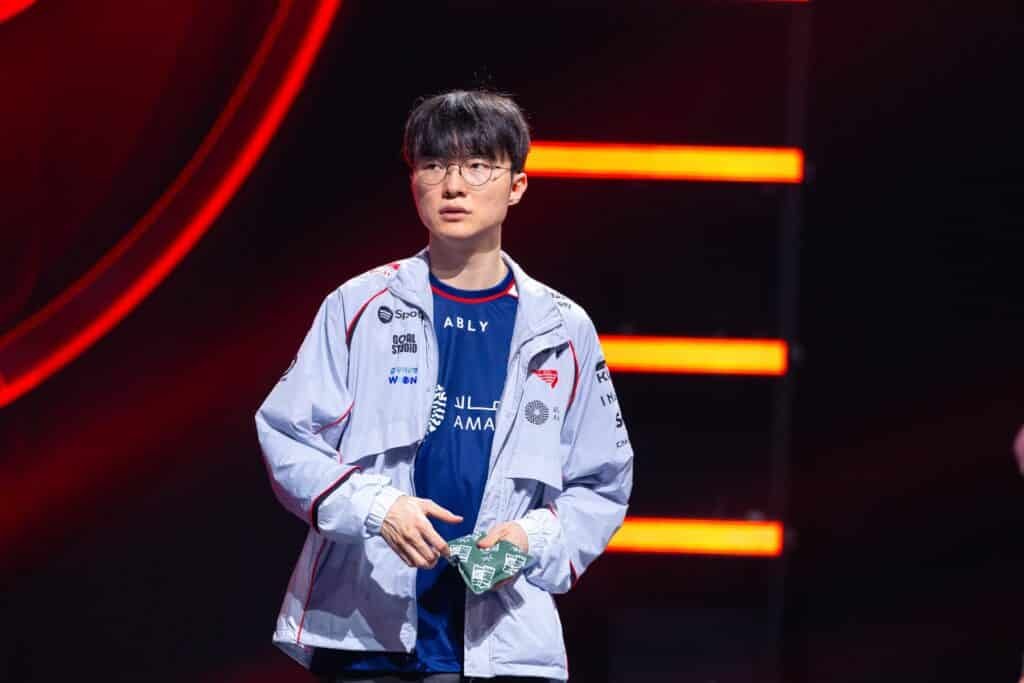
He’s probably not wrong to consider Faker in the same breath as Messi and Pele, but for most outside of the scope of esports, it’s hard to really understand Faker and, by proxy, T1’s impact.
I take a moment to listen to the voices at T1 Base Camp, and I hear predominantly Korean. As I listen closer and walk through the hundreds of computers, the conversations start to vary, ranging from Mandarin to the Romance languages.
I’ve always known how big League of Legends is in Korea and how big Faker is in the general zeitgeist. I also know how big soccer culture is, particularly in Europe, having been to England for Premier League and Champions League games.
It got me wondering how big T1 is and, by extension, League of Legends?
You gotta be two hours early, every time: T1 could be bigger than some traditional sports icons
The day I arrived in Daejeon, South Korea, where League of Legends’ Mid-Season Invitational was being hosted, a pair of second-place teams – North America’s Team Liquid Alienware and Europe’s Karmine Corp – were on the schedule.
The venue, configured to fit a few thousand fans, had a reasonable showing, but without a Korean team to pull attendance, attendance was relatively sparse all things considered.
That changed the following day when T1 was on the docket.
For context, I get to games early, mostly out of habit, to avoid feeling rushed. I know there are some fans who share this early-arrival habit, but when I arrived two hours before the T1-TLAW match, the queues were filled.
This became increasingly astonishing once the tournament reached the bracket stage.
Whether it was the top seed from the League Championship of Korea and Daejeon-based Hanwha Life Esports or T1, fans lined up two hours before the first match, usually at noon, hoping to grab a seat at the venue.
Mind you, the latest a game could start at MSI was 5 p.m.
“Going overseas for international tournaments is great, but playing an international tournament in Korea is special,” HLE mid-laner Kim “Zeka” Geon-woo said to Esports Insider. “We feel a strong sense of responsibility and pride.”
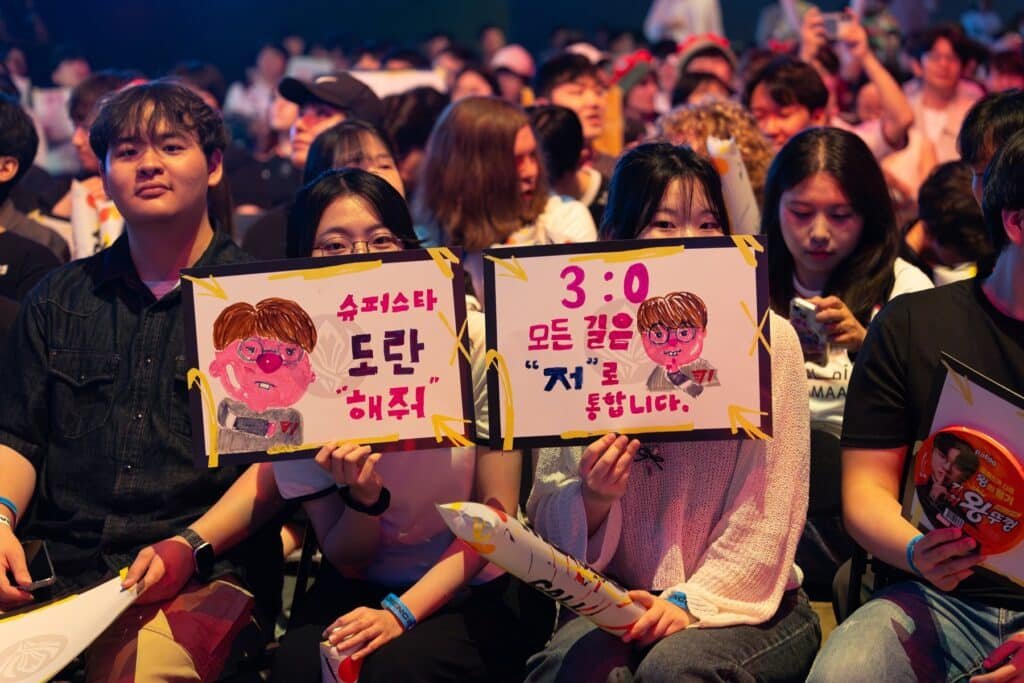
While all teams were well represented at the event, T1 featured the most diverse range of fans. Fans from Australia, the United States, Mexico, France, and the Philippines were just part of the range of countries that wore the T1 colors.
Most had Faker name plates, but there were several Keria, Oner, Doran, and Peyz jerseys to go around.
“I feel like T1 is a team that’s consistently making history,” Ryu “Keria” Min-seok said. “I think the fans in Korea and overseas are cheering for us with the same heart, so I don’t think there’s a big difference.”
Of the fans I spoke to who wore these jerseys, many cite Faker as the point of entry.
“His aura,” said Marel Martin, who was born in the U.S., raised in the Philippines, and stationed in Korea. “Before I actually got here in Korea, when I was in the Philippines, I was just hearing about T1, and not everyone knows it. But once I got to Korea, I’m like, ‘Wow, his legacy is actually outstanding.’”
Martin admitted that his family was also surprised that Faker had gravitas equal to or greater than that of the popular K-Pop band BTS.
“He’s just so great,” Martin said. “That’s why there’s a reason he’s called the GOAT, the greatest of all time, and actually deserves that name.”
What does Faker think of the praise he receives from his fans? While he doesn’t mind being the GOAT, or in some cases God, he did admit to me that it comes with a level of expectation.
“I don’t really pay much attention to what other people call me,” Faker said. “But if people call me that, I feel I need to show a performance that matches it.”
The need to perform at a high level has trickled down to his teammates, who share the same belief in themselves.
Fifty minutes was all it took
Every tournament, T1 is expected to win. That’s the reputation they have built, and wearing the logo on their shirt brings the expectation and pressure with it.
“At first, rather than having those kinds of thoughts [of living up to the expectations], I just worked hard,” Moon “Oner” Hyeon-jun said. “As I kept going, those aspects seemed to grow, and I am very thankful. Honestly, being a member of T1 doesn’t really change anything about being a pro gamer for me, so I just try to keep working hard.”
T1 breezed through the play-in stage, going undefeated 9-0 over three series. Fans cheered whenever Faker – or any T1 player, for that matter – was shown prominently. The volume at T1 rivaled that of some of the hockey games I’ve covered live.
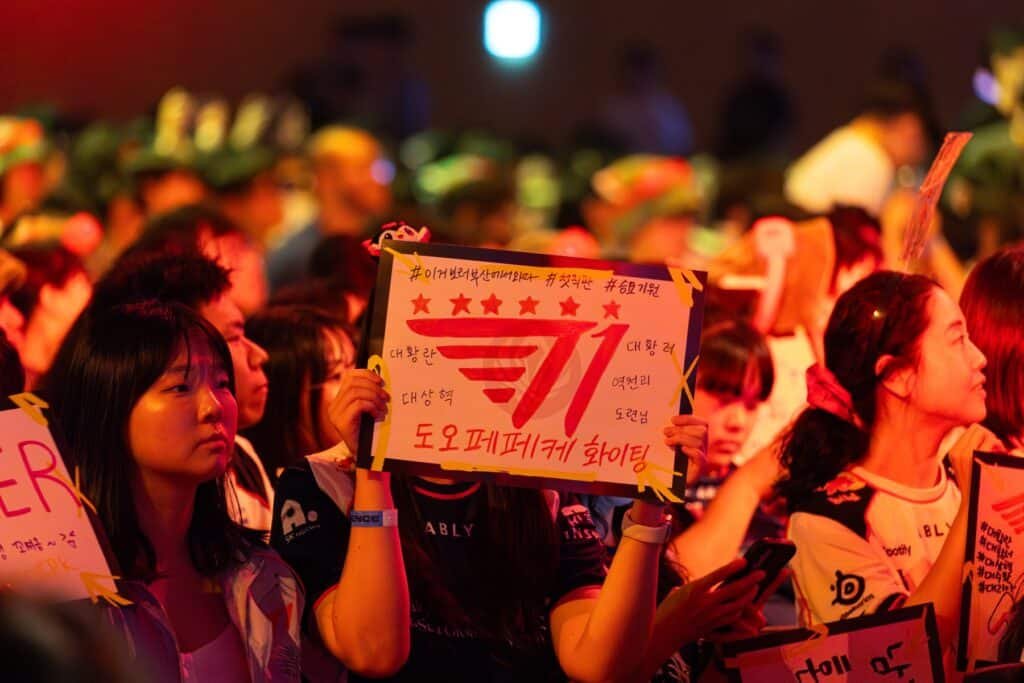
Add in the inflatable thunder sticks, the support signs, the sign-creation stations, and the fan fiesta happening a few hundred meters away, and it felt like a massive deal.
Faker and the team drew Bilibili Gaming, a Chinese team, in the first bracket stage. T1 has been a perennial thorn in BLG’s side, eliminating them from several international events, including the 2023 and 2024 World Championships and the 2024 Esports World Cup.
The teams went into a back-and-forth five-game series, with BLG getting the upper hand over their longtime nemesis, 3-2. The loss sent T1 into the lower bracket, meaning they were one loss away from ending their run.
“It was a match I came in looking forward to today,” Oner said. “There were many things that didn’t work out well among us, so I think it was a very disappointing day.”
T1 recovered, sweeping the Brazilian team FURIA, setting up a matchup with G2 – the European team considered one of the best the Western Hemisphere has to offer.
T1 lost the first two games to G2. The crowd swelled, drowning out small chants for G2.
T1 managed to force a Game 4 and jumped out to a quick advantage. But what occurred over the next 50 minutes was the type of drama sports – both electronic and traditional – are built upon.
T1 and G2 took fans on a roller coaster of emotions with each team securing major moments of triumph and disappointment. The final 10 minutes, for lack of a better comparison, felt like a football match going into extra time, with the teams playing until a goal was scored.
Every moment from posturing that never led to skirmishes to nail-biting escapes was met with cheers, jeers, and exasperated gasps.
G2 hemmed T1 in at their base, who valiantly bided their time, waiting for the right moment to push the proverbial go button.
But as the waves began closing in, T1 finally made its last stand.
The crowd roared to life, rooting for their beloved T1 to make the stand and pull out another miracle, as T1 always does on the biggest stages.
“We have a lot of experience on bigger stages,” Keria said. “So, when it matters the most, I think our teammates and I have a lot [of knowledge] to play better in those moments.”
T1 bottom laner Peyz secured a kill, sending the crowd into a frenzy.
But lost in the scramble and the joy of the moment was G2 top laner BrokenBlade’s Kled attacking the Nexus. The red life bar grew empty.
Then at 50:57, the crowd let out a groan.
What comes with the logo
The moment the nearly 51-minute classic ended, staff exited G2’s coaches’ room and stormed onto the stage to hug their players.
It confirmed that there would be no long lines of Faker, Keria, Oner, Doran, and Peyz jerseys. No track jackets or signs ushering on T1 to make a run for an MSI title.
Instead, all that remained was a stunned crowd that had just seen a titan of esports suffer defeat in Korea.
As the players collected their gear, the broadcast pointed its cameras at Faker. The icon, who had seen just about everything in League of Legends, turned away from the camera, kept his hands on his hips, and waited for his teammates to walk by so he could join them for the end-of-series bow to a crowd that roared with every kill and gasped with every death over the past week.
The team walked off the stage to decompress after an intense four-game series, but there won’t be much time to rest and reflect.
In less than a week, T1 will be in Paris for the Esports World Cup. After that, the road to defend their World Championship begins with the Summer LCK Split, with eyes set on ending 2026 with a fourth-straight title in the Barclays Center in Brooklyn.
MSI ended disappointingly for T1. That’s what happens when you’re the League of Legends equivalent of Real Madrid and FC Barcelona. Expectations are high.
For Oner, that’s perfectly acceptable.
“I am very thankful for [the fans],” Oner said. “Because of that support, rather than feeling pressure, it serves as motivation for us to work even harder.”
T1 stands tall as the beacon of what esports has become in Korea, and performance is expected of both players and fans.
It’s what comes with being the premier organization.
It’s what happens when you have the GOAT.
It’s what happens when your fans spread around the world.
It’s championship or bust every time.
Built on loyalty
Nothing in sports surprises me. The stories will loop.
Teams become an unstoppable force. Then underdogs win, and legendary teams fall.
Korea’s League of Legends scene isn’t comparable to the other regions around the world. It lives and functions the same as traditional sports leagues do.
I wasn’t sure what to expect when I got to Daejeon to cover my first League of Legends event in Korea.
I can’t necessarily say I was surprised by the tournament itself.
Rather, it’s the ones who traveled to Korea and dragged their friends and family to see what the League of Legends culture is like. It’s one thing to be a League fan and come to Korea, but another to drag people with no connection to it along is another level of dedication.
So how big is League of Legends?
For me, it’s at the level of European soccer and college football in the United States, built on the bedrock of loyalty. It’s a regionally powerful sport that needs to be experienced in person to appreciate.
So, when I think about it like that, I can see why Valencia dragged his family to the Hongdae District to see T1 Base Camp.
It’s just what fans do.
The sign to T1 Base Camp is easy to spot. There’s enough red to make it stand out. The arrow pointing down the stairs to the PC Bang and store dedicated to T1 and its players in Seoul’s Hongdae neighborhood is accompanied by pictures of the team’s past success.
At the bottom of the stairs, through the doors, I enter and take in the familiar feeling of a bunch of computers in one space for gaming. It’s something that brought me back to my high school days of the cybercafé, where I recall players yelling at each other over Counterstrike 1.6 and CS Zero.
Unlike the dark, dungeon-like feel, this is well-lit and clean, with state-of-the-art computers that can run games at the highest resolution. There’s a snack bar selling themed drinks with some highlighted as player favorites.
Then, among a sea of Korean voices, I hear English. It tends to stand out in these spots. I turned around, approached the person, and asked if I could interview them about why they’re at T1 Base Camp.
Sadly, I never got this man’s name before he said, “Interview my brother. He LOVES this.”
I nod and wait for his brother, who was wrapping up at a computer.
When Jose Valencia introduced himself, he was decked out in T1 gear and excited to chat about T1 and his thoughts about the PC Bang.
“In Mexico, we have the old-style cybers,” Valencia said. “They’re not even close to this. It’s actually a little bit overwhelming.”
So how did Valencia and his family get here?
While on a family trip from Mexico to East Asia, Valencia convinced his family to stop at T1 Base Camp. He admitted it took a little convincing, comparing T1 to well-known soccer clubs, Real Madrid and FC Barcelona.
“If you’re a Barcelona fan when you go to Camp Nou, if you’re a Real Madrid fan, if you go to their stadium, Bernabeu,” he said.
Lee Sang-hyeok, better known by his gamer tag Faker, is the heart of T1. His picture, signature, and image are plastered on the walls, and there’s even a large cartoon statue of him in the lobby.
He’s a player who needs no introduction in esports, but Valencia continued his football analogy to help his family understand.
“I had to explain to them if he’s like the [Lionel] Messi of League of Legends,” Valencia said. “Except bigger, probably bigger, in its sport because he’s probably like Pele from soccer.”
He’s probably not wrong to consider Faker in the same breath as Messi and Pele, but for most outside of the scope of esports, it’s hard to really understand Faker and, by proxy, T1’s impact.
I take a moment to listen to the voices at T1 Base Camp, and I hear predominantly Korean. As I listen closer and walk through the hundreds of computers, the conversations start to vary, ranging from Mandarin to the Romance languages.
I’ve always known how big League of Legends is in Korea and how big Faker is in the general zeitgeist. I also know how big soccer culture is, particularly in Europe, having been to England for Premier League and Champions League games.
It got me wondering how big T1 is and, by extension, League of Legends?
You gotta be two hours early, every time: T1 could be bigger than some traditional sports icons
The day I arrived in Daejeon, South Korea, where League of Legends’ Mid-Season Invitational was being hosted, a pair of second-place teams – North America’s Team Liquid Alienware and Europe’s Karmine Corp – were on the schedule.
The venue, configured to fit a few thousand fans, had a reasonable showing, but without a Korean team to pull attendance, attendance was relatively sparse all things considered.
That changed the following day when T1 was on the docket.
For context, I get to games early, mostly out of habit, to avoid feeling rushed. I know there are some fans who share this early-arrival habit, but when I arrived two hours before the T1-TLAW match, the queues were filled.
This became increasingly astonishing once the tournament reached the bracket stage.
Whether it was the top seed from the League Championship of Korea and Daejeon-based Hanwha Life Esports or T1, fans lined up two hours before the first match, usually at noon, hoping to grab a seat at the venue.
Mind you, the latest a game could start at MSI was 5 p.m.
“Going overseas for international tournaments is great, but playing an international tournament in Korea is special,” HLE mid-laner Kim “Zeka” Geon-woo said to Esports Insider. “We feel a strong sense of responsibility and pride.”
While all teams were well represented at the event, T1 featured the most diverse range of fans. Fans from Australia, the United States, Mexico, France, and the Philippines were just part of the range of countries that wore the T1 colors.
Most had Faker name plates, but there were several Keria, Oner, Doran, and Peyz jerseys to go around.
“I feel like T1 is a team that’s consistently making history,” Ryu “Keria” Min-seok said. “I think the fans in Korea and overseas are cheering for us with the same heart, so I don’t think there’s a big difference.”
Of the fans I spoke to who wore these jerseys, many cite Faker as the point of entry.
“His aura,” said Marel Martin, who was born in the U.S., raised in the Philippines, and stationed in Korea. “Before I actually got here in Korea, when I was in the Philippines, I was just hearing about T1, and not everyone knows it. But once I got to Korea, I’m like, ‘Wow, his legacy is actually outstanding.’”
Martin admitted that his family was also surprised that Faker had gravitas equal to or greater than that of the popular K-Pop band BTS.
“He’s just so great,” Martin said. “That’s why there’s a reason he’s called the GOAT, the greatest of all time, and actually deserves that name.”
What does Faker think of the praise he receives from his fans? While he doesn’t mind being the GOAT, or in some cases God, he did admit to me that it comes with a level of expectation.
“I don’t really pay much attention to what other people call me,” Faker said. “But if people call me that, I feel I need to show a performance that matches it.”
The need to perform at a high level has trickled down to his teammates, who share the same belief in themselves.
Fifty minutes was all it took
Every tournament, T1 is expected to win. That’s the reputation they have built, and wearing the logo on their shirt brings the expectation and pressure with it.
“At first, rather than having those kinds of thoughts [of living up to the expectations], I just worked hard,” Moon “Oner” Hyeon-jun said. “As I kept going, those aspects seemed to grow, and I am very thankful. Honestly, being a member of T1 doesn’t really change anything about being a pro gamer for me, so I just try to keep working hard.”
T1 breezed through the play-in stage, going undefeated 9-0 over three series. Fans cheered whenever Faker – or any T1 player, for that matter – was shown prominently. The volume at T1 rivaled that of some of the hockey games I’ve covered live.
Add in the inflatable thunder sticks, the support signs, the sign-creation stations, and the fan fiesta happening a few hundred meters away, and it felt like a massive deal.
Faker and the team drew Bilibili Gaming, a Chinese team, in the first bracket stage. T1 has been a perennial thorn in BLG’s side, eliminating them from several international events, including the 2023 and 2024 World Championships and the 2024 Esports World Cup.
The teams went into a back-and-forth five-game series, with BLG getting the upper hand over their longtime nemesis, 3-2. The loss sent T1 into the lower bracket, meaning they were one loss away from ending their run.
“It was a match I came in looking forward to today,” Oner said. “There were many things that didn’t work out well among us, so I think it was a very disappointing day.”
T1 recovered, sweeping the Brazilian team FURIA, setting up a matchup with G2 – the European team considered one of the best the Western Hemisphere has to offer.
T1 lost the first two games to G2. The crowd swelled, drowning out small chants for G2.
T1 managed to force a Game 4 and jumped out to a quick advantage. But what occurred over the next 50 minutes was the type of drama sports – both electronic and traditional – are built upon.
T1 and G2 took fans on a roller coaster of emotions with each team securing major moments of triumph and disappointment. The final 10 minutes, for lack of a better comparison, felt like a football match going into extra time, with the teams playing until a goal was scored.
Every moment from posturing that never led to skirmishes to nail-biting escapes was met with cheers, jeers, and exasperated gasps.
G2 hemmed T1 in at their base, who valiantly bided their time, waiting for the right moment to push the proverbial go button.
But as the waves began closing in, T1 finally made its last stand.
The crowd roared to life, rooting for their beloved T1 to make the stand and pull out another miracle, as T1 always does on the biggest stages.
“We have a lot of experience on bigger stages,” Keria said. “So, when it matters the most, I think our teammates and I have a lot [of knowledge] to play better in those moments.”
T1 bottom laner Peyz secured a kill, sending the crowd into a frenzy.
But lost in the scramble and the joy of the moment was G2 top laner BrokenBlade’s Kled attacking the Nexus. The red life bar grew empty.
Then at 50:57, the crowd let out a groan.
What comes with the logo
The moment the nearly 51-minute classic ended, staff exited G2’s coaches’ room and stormed onto the stage to hug their players.
It confirmed that there would be no long lines of Faker, Keria, Oner, Doran, and Peyz jerseys. No track jackets or signs ushering on T1 to make a run for an MSI title.
Instead, all that remained was a stunned crowd that had just seen a titan of esports suffer defeat in Korea.
As the players collected their gear, the broadcast pointed its cameras at Faker. The icon, who had seen just about everything in League of Legends, turned away from the camera, kept his hands on his hips, and waited for his teammates to walk by so he could join them for the end-of-series bow to a crowd that roared with every kill and gasped with every death over the past week.
The team walked off the stage to decompress after an intense four-game series, but there won’t be much time to rest and reflect.
In less than a week, T1 will be in Paris for the Esports World Cup. After that, the road to defend their World Championship begins with the Summer LCK Split, with eyes set on ending 2026 with a fourth-straight title in the Barclays Center in Brooklyn.
MSI ended disappointingly for T1. That’s what happens when you’re the League of Legends equivalent of Real Madrid and FC Barcelona. Expectations are high.
For Oner, that’s perfectly acceptable.
“I am very thankful for [the fans],” Oner said. “Because of that support, rather than feeling pressure, it serves as motivation for us to work even harder.”
T1 stands tall as the beacon of what esports has become in Korea, and performance is expected of both players and fans.
It’s what comes with being the premier organization.
It’s what happens when you have the GOAT.
It’s what happens when your fans spread around the world.
It’s championship or bust every time.
Built on loyalty
Nothing in sports surprises me. The stories will loop.
Teams become an unstoppable force. Then underdogs win, and legendary teams fall.
Korea’s League of Legends scene isn’t comparable to the other regions around the world. It lives and functions the same as traditional sports leagues do.
I wasn’t sure what to expect when I got to Daejeon to cover my first League of Legends event in Korea.
I can’t necessarily say I was surprised by the tournament itself.
Rather, it’s the ones who traveled to Korea and dragged their friends and family to see what the League of Legends culture is like. It’s one thing to be a League fan and come to Korea, but another to drag people with no connection to it along is another level of dedication.
So how big is League of Legends?
For me, it’s at the level of European soccer and college football in the United States, built on the bedrock of loyalty. It’s a regionally powerful sport that needs to be experienced in person to appreciate.
So, when I think about it like that, I can see why Valencia dragged his family to the Hongdae District to see T1 Base Camp.
It’s just what fans do.
